Where do we start?
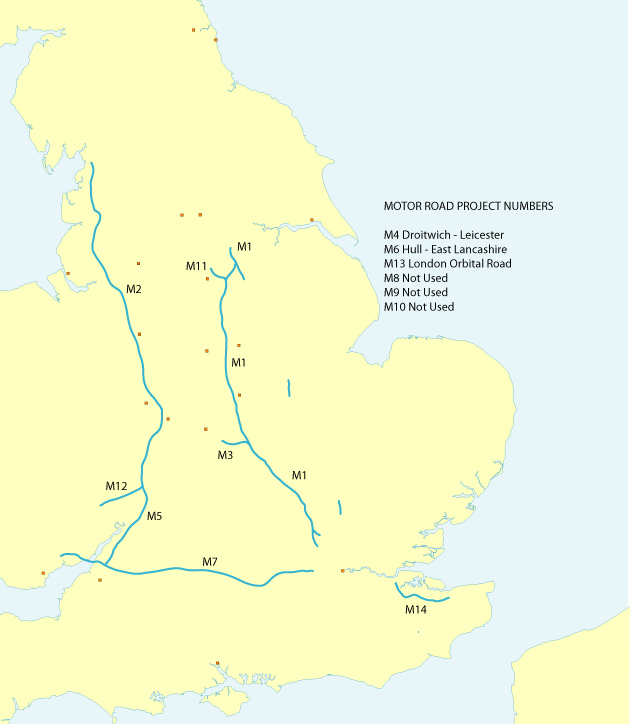
The earliest form of numbering related to “Motor Road” project numbers. “Motor Roads” being an early name for motorways.
This was a system that was completely divorced from the all-purpose system, and the motorways would be allocated numbers based on a big list held at the Ministry and the next one in the list handed out. There would be no geographical basis to the numbers, unlike for the all-purpose system.
Motor Road project numbers were developed in the late 1940’s as a shorthand for the motorway alignments county surveyors were asked to fix for planning purposes.
The major drawback with this system was the lack of systematic numbering, so that the final motorway network would consist of completely random numbers.
In true Ministry fashion, it was intended solely as an internal system. Mind you, as we’ve seen, that was the original idea behind numbering roads in the first place!
Some examples of numbers assigned using this scheme are:
M1 London – Yorkshire Motorway
M2 Birmingham – Lancaster Motorway
M5 Birmingham – Exeter Motorway
Oddly, the scheme appears to lapse in the mid-1950s – just at the point where motorway construction is starting.
Motor Road project numbers, early 1950s.
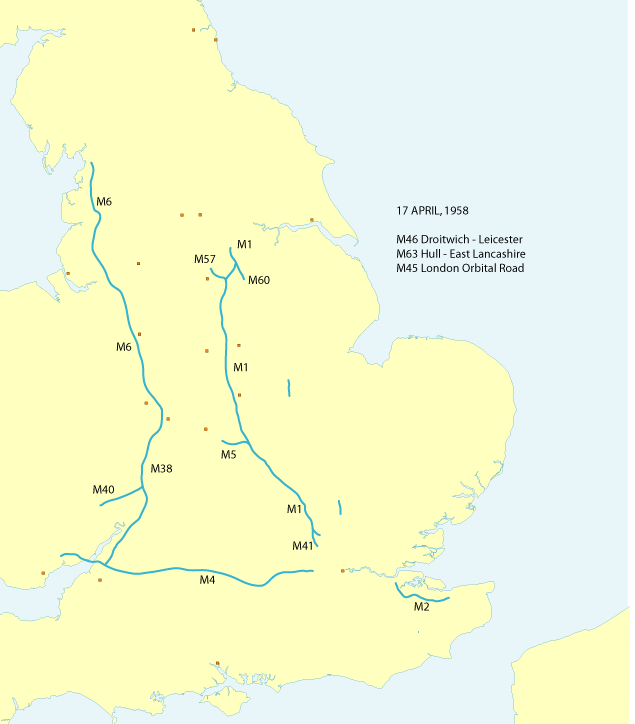
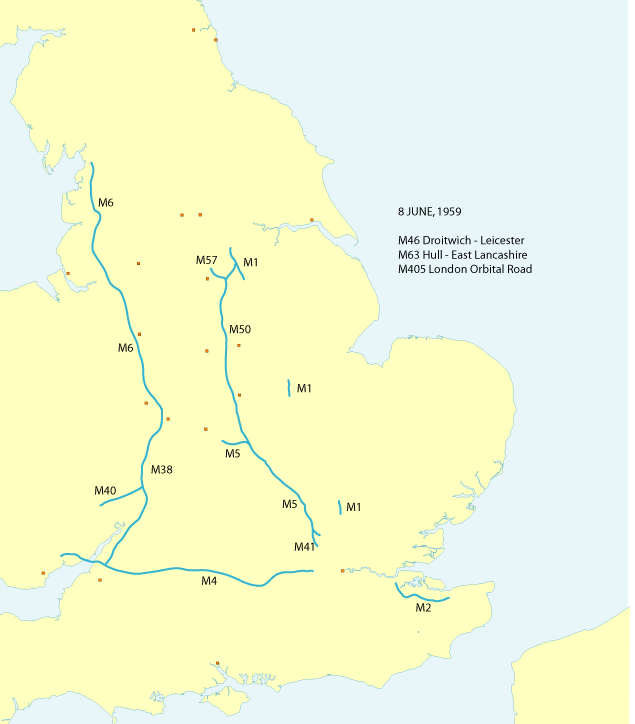
Things move on – 17th April, 1958.
Construction on the Preston Bypass is well under way, and work has started on several other early motorways, including what is now the M1.
No decision has been made yet, and so memos are being written regarding suggestions.
W. Hadfield at the Ministry sits down and starts to dictate. These are some extracts from that very memo, held in the National Archives in Kew, London.
“With a view to continuing this [the in-place] system, the number A.50 has in fact been reserved in anticipation for the London – Birmingham Motorway, with the idea that it would form a parallel to A.5, and again largely on the clockwise side of it, but we have not equivalent reservations for all the other routes; some would need to go into three figures e.g. A.200, and we run into difficulties where the motorways may be said to radiate from Birmingham rather than London.
In respect of the possibility of our including European numbers on some of these motorways, it is thought that as such numbers would be in special colours, namely, white on green, and that so far there are only eight of them, we might introduce a new system of numbers for the motorways with the letter M, giving for home travellers three systems, namely M, A and B. The distinctive letter will have a particular advantage, in that it will immediately tell drivers who see a signpost to an M route that it will be subject to motorway conditions, so that drivers can choose or reject it purely on that account.”
This is an early mention of the use of the M prefix that we know today. Another interesting thing about this section of the memo is the way that it talks about the possibility of using European “E” numbers on signs. Whilst the thought of white on green signs seems perfectly normal to us today, back in 1958, the modern white on green signage was still nearly ten years away. And of course, “E” numbers have never made it onto UK signage.
The memo continues:
When we have short spurs on roads, they are sometimes given separate numbers, but occasionally the the same number is used for both arms of the spur. This latter alternative has both advantages and disadvantages, and I think it should only be adopted when the spurs are quite short, so that a driver who might choose the wrong arm is not taken far out of his way. Clearly the forked junction planned for the southern end of the Preston Bypass would have the same number, though drivers approaching it should take the right hand fork for Wigan, and the left hand fork for Manchester. However, if a driver wanting Wigan happens to take the left hand fork, he has not gone far from the shortest route.
This therefore lays the groundwork for the modern approach of short spurs not getting their own number, for example the Gatwick Airport Spur from the M23, the Heathrow Airport spur from the M4 and the Manchester Airport spur from the M56.
Now, let’s get on to the meaty parts:
With these principles in mind, let us try to apply them to the projected motorways. The London – Birmingham – Doncaster one at its southern end might be more properly labelled as M.5 at its southern part, and M.1 north of Birmingham. However, the system is not applied inflexibly without regard to common sense, and that suggests that this route should be M.1 between London and Doncaster, with the branch to Birmingham M.5. As regards the spurs, I think we would run into difficulty if we tried to number them seriatim starting from London. Clearly the addition of spurs subsequently would upset such numbering, and M.5 would then not be appropriate for the Birmingham Branch as a parallel to A.5. The alternative is to number the spurs in relation to the equivalent A routes, which suggests that the southern spur near London be numbered M.41, that going north to Sheffield M.57 and that south of Doncaster M.60.
Continuing this system the Medway Towns Bypass would be M.2, and the sections bypassing Slough and Maidenhead and going north of Bristol to South Wales M.4. The northern one from Birmingham might conveniently be called M.6, and the Birmingham – South Wales one M.38 terminating at the Severn Bridge, with M.40 for the Ross Spur.
The Hull – East Lancs. route could be M.63, the Droitwich – Leicester route M.46. The London Orbital Road is not immediately obvious, the present north orbital number being 405, and we might have to compromise with the system, for example to call this M.45.
It will readily be appreciated that short numbers will help with the size of signs, and hence it is suggested that we should never have more than two digits.
My life, there’s a lot there. Some will be familiar-sounding, some not. The most stark difference is that one of the most-often asked questions about motorway numbering has an answer. That question is, of course, “Why isn’t the M5 called the M38?”. Well, under this suggested system, it was!
April 1958 suggested numbering following nearest A class road