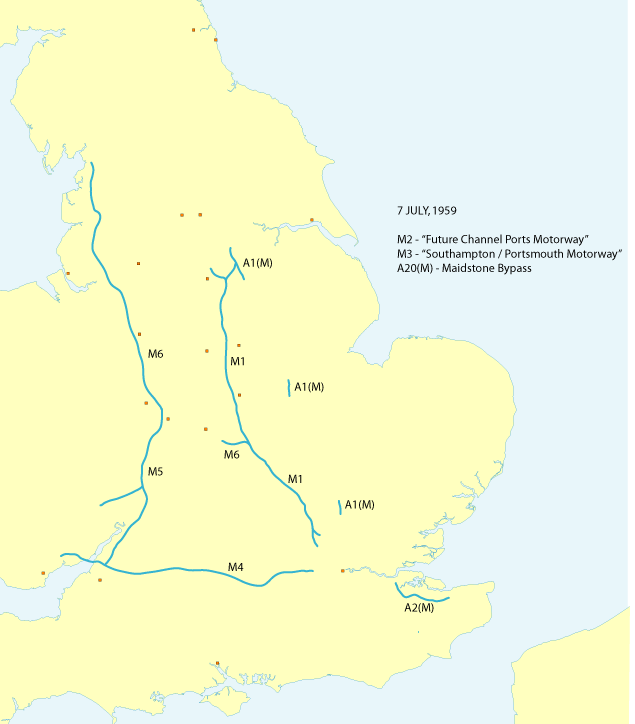
Panic stations – 11 June, 1959
Government departments do not make decisions quickly!
C. H. Wykes of the Road Traffic Division notes a problem, and tries to hurry the process along in this memo address to the Divisional Road Engineers (who were the heads of the geographical Divisions which were part of the Ministry’s decentralized structure):
It has been decided that the numbering of motorways will be the responsibility of Road Traffic Division.
The signposting of the London – Birmingham Motorway is now a matter of some urgency and its numbering is clearly an essential feature of this signposting. It is desirable, however, that for the purposes for numbering the London – Birmingham Motorway should be considered not in isolation but in conjunction with all other motorways now proposed.
For this reason I should be grateful if you would let me have, by say the end of next week, a list of all motorways coming within the purview of your Division, no matter how remote in time these may be or how early the stage of planning reached. By “motorways” I mean all roads, including bypasses and county roads, such as the Stretford – Eccles Bypass, to be built to motorway standards and subject to motorway regulations. Any cases where the latter point is doubtful should be included in the list and indicated as such and in all cases it will be helpful if the approximate route could be shown on the list. Maps would be particularly helpful if these were available but they are not essential.
Some urgency? Some urgency? The opening of the London – Birmingham Motorway is only a few months away…
A new proposal – 7 July, 1959
C. H. Wykes writes:
It is necessary that we should bring to a head what is to be done about numbering motorways. We have had a road-numbering system for many years – A for Trunk and Class I roads and B for other classified roads – and the system serves a number of useful purposes, enabling routes to be simply identified, signposted and followed and to be so shown on road maps. Professional drivers make great use of the system and I do not think that it is a matter of very great moment that some private motorists prefer to work on names alone.
After consultation with Highways Engineering and the Highways Divisions I recommend that Motorways should have a coherent numbering system of their own – in any case, they could hardly be assimilated to the system as all the single numbers and nearly all the 2-figure numbers have already been used. The obvious prefix is M.
The system we propose would be modelled on the A system i.e. with London as a centre and going clockwise from the motorway to the north as a starting point, the numbers from 1 to 6 should be allocated. The numbers 7, 8 and 9 should, as in the A system, be reserved for Scotland even though we are not aware of any Scottish motorway plans at this stage.
The double figure numbers would be reserved on the principle that M.10 to M.19 would be available for the sector between M.1 and M.2, M.20 to M.29 for the sector between M.2 and M.3 – and so on. Sixty-six numbers would thus be available and these should be adequate for all foreseeable needs in England and Wales without recourse to any 3-figure numbers.
Where a motorway was merely a by-pass on a recognised continuous route, such as A.1, it would not be given a separate M number but, in order to make clear its motorway status and that the special motorway regulations applied to it, the letter M would be added in brackets to the existing route number e.g. A.1(M). This would avoid chopping and changing of numbers along such routes.
The result of applying such a system to current plans would be the appropriate numbering of the London – Yorkshire Motorway as M.1, with provision for extension still further north as required. M.2 would be reserved for any possible Channel Ports Motorway, the Medway Towns Bypass meanwhile becoming A.2(M) and the Maidstone Bypass A.20(M). M3 would be reserved for a motorway in the direction of Portsmouth – Southampton, starting with the Exeter Radial. M.4 would be applied to the South Wales Radial. The remaining single figure numbers would not be required for radials and could therefore, continuing clockwise, be applied to the Bristol – Birmingham Motorway – M.5 and the Penrith – Birmingham plus Dunchurch Bypass – M.6. The Preston Bypass was numbered M.6 in advance and although under these proposals it should initially have been A.6(M), I see no reason to make any change from M.6 pending the ultimate completion of the whole route.
If approval can be given to this general system to govern motorway numbering, there should be scope for fitting in all foreseeable developments for may years to come – and we can proceed, at once, with the proper numbering of the London – Birmingham sections of M.1 and M.6.
The copy of this memo held in the National Archives has some wonderful handwritten notes at the bottom in several different sets of handwriting, including the following comments:
Noted. The Brighton Radial will presumably be M.21 (or M.23?) on this basis. 30/7/59
and
I have spoken to Mr. Wykes and pointed out that the Dunchurch Spur is not now expected to be continued to the Birmingham – Penrith Motorway; it should not therefore be numbered M.6 but M.12 or something of that sort. I have also suggested that some consideration be given to using a single number for the Bristol – Birmingham and Birmingham – Penrith Motorways.
This, therefore, is the first mention of the “sector” system of numbering. More will be said about this one over time…